PSL stands for Physical Sub-Sexual Looks.
It is not an insult, not a meme, and not a trend. PSL is a framework used to describe how male facial structure is perceived based on measurable anatomical traits rather than opinions, fashion, or personality.
In simple terms:
PSL answers one question — how strong does your face read at first glance, before you speak?
This is why PSL matters in dating, social dominance, professional presence, and self-improvement. Humans make facial judgments in milliseconds, and those judgments are largely driven by bone structure, symmetry, and tissue distribution.
Why PSL Exists (And Why People Care)
People search for PSL because traditional “confidence advice” fails to explain reality.
Two men can have the same confidence, hygiene, and clothing — yet receive very different reactions. PSL explains why.
Facial attractiveness is not random. It follows biological patterns shaped by evolution, hormones, and skeletal development. PSL organizes these patterns into a structured scale.
This does not mean “you are doomed.”
It means you can identify what matters and what can realistically be improved.
The PSL Scale (Explained Clearly)
PSL is commonly represented on a numeric scale:
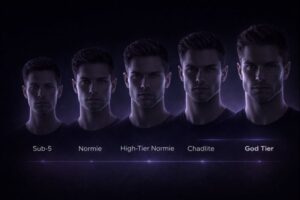
• 1.0 – 3.9 (Sub-5):
Major structural disadvantages. Weak bone projection, poor harmony, low visual presence.
• 4.0 – 4.9 (Normie):
Average structure. Blends into the crowd. No strong positives or negatives.
• 5.0 – 5.9 (High-Tier Normie):
Above average. Some strong traits, but masked by soft tissue or imbalance.
• 6.0 – 6.9 (Chadlite):
Top 10%. Clear bone dominance, strong jaw or eyes, visible structure.
• 7.0 – 7.9 (Chad):
Model tier. Rare symmetry, elite ratios, strong sexual dimorphism.
• 8.0+ (God Tier):
Extremely rare genetic outliers. Near-perfect structure.
Most men fall between 4.5 and 6.0 — the “grey zone” where optimization actually works.
What Determines PSL? (The Core Variables)
PSL is not about one feature. It’s about how multiple systems interact.
1. Bone Structure (Primary Driver)
Bone determines facial dominance more than skin, beard, or hairstyle.
Key skeletal markers include:
• Jaw width and gonial angle
• Cheekbone projection
• Chin forward growth
• Brow ridge structure
• Midface length
If bone is weak, no haircut fixes it.
If bone is strong but hidden, PSL rises quickly with optimization.
2. Soft Tissue (The Mask)
Many men have good bone but poor PSL because it’s hidden.
Common soft-tissue issues:
• Facial fat
• Water retention (edema / “moon face”)
• Inflammation
• Poor skin texture
This is why people often look better after fat loss — bone didn’t change, visibility did.
3. Eye Area (The Halo or the Failo)
Eyes can save or destroy a PSL score.
High-impact eye traits:
• Canthal tilt (positive vs negative)
• Scleral show
• Eyelid exposure
• Eye spacing (IPD relative to face width)
Strong eyes create a halo effect. Weak eyes often become the main failo.
You may also read: The JawMax Bible: A Guide to Your 16 Facial Metrics
4. Facial Harmony
No single trait matters alone.
PSL rewards:
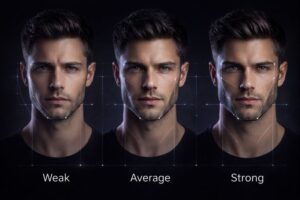
• Balanced proportions
• Symmetry
• Cohesion between upper, mid, and lower thirds
A strong jaw with poor midface harmony still scores lower than expected.
What PSL Is NOT
PSL is NOT:
• A judgment of your worth
• A prediction of your success
• A replacement for personality
• A guarantee of outcomes
PSL describes visual impact, not destiny.
Ignoring PSL doesn’t make it disappear — it just makes feedback confusing.
Can PSL Be Improved?
Yes — but within limits.
There are two categories:
Softmaxxing (Realistic Improvements)
These affect visibility, not bone:
• Fat reduction
• Skin quality
• Grooming
• Posture
• Hair and beard optimization
Most men can gain +1.0 to +2.0 PSL points through softmaxxing.
Hard Limits (Genetics)
Bone structure has ceilings.
No app or exercise changes skull shape in adulthood.
Understanding this prevents false hope — and wasted effort.
Why AI-Based PSL Analysis Matters
Human feedback is biased, inconsistent, and emotional.
AI analysis (like UMAX AI’s PSL Warlord) does three critical things:
• Measures consistently
• Separates bone from soft tissue
• Explains why a score exists
Instead of vague advice, users get:
• Clear strengths
• Clear bottlenecks
• Realistic potential
This is why PSL analysis tools are exploding in popularity — especially among Gen Z.
Frequently Asked PSL Questions (Answered Clearly)
1. What does PSL stand for?
Physical Sub-Sexual Looks — a framework describing male facial attractiveness based on anatomy.
Is PSL real or just internet slang?
The term is internet-born, but the concepts come from evolutionary biology, facial anthropology, and aesthetic medicine.
What is a good PSL score?
5.5+ is above average.
6.0+ is rare.
7.0+ is elite.
Can gym or mewing increase PSL?
Gym improves body composition and neck thickness (helpful).
Mewing does not change adult bone structure, but posture can improve appearance.
Why do some average guys get more attention than better-looking ones?
Context, confidence, and environment matter — but PSL still influences first impressions.
Is PSL analysis toxic?
Only if misunderstood. Objective data is not toxic — denial is.